
I may be wrong, but I can't help feeling that my understanding of what organisation is all about is different from that of my neighbours.
Recent experiences are the cause of that feeling. Together with some others I'm involved in setting up two different organisations here in Aston. Organisation means influence, power if you like, and that is a scarce commodity in a deprived neighbourhood. Organisations are rather crucial in having one's voice heard.
In preparing for the two organisations it was unavoidable to discuss frameworks and constitutions. The discussion brought home to me two concerns I had not really thought of before. One said that great care should be taken not to exclude anyone and certainly not persons with a kind of following. They may turn against you if they are not properly acknowledged. The second concern was even more interesting. It had to do with the possibility that one particular group of people, a large family or a network of family and friends, would try to hijack the organisation for its own particular ends.
These concerns struck me, because so far I had thought of my organisational efforts as an attempt to bring people of different backgrounds together. It was all about bridge-building for the sake of the community as a whole. But apparently, this is not how my partners in the discussion looked at things. Perhaps, they thought me rather naive, as they had stories to tell of how organisations have been used not to serve the common good but to benefit the leaders.
It brought home to me that the 'common good' is very much an abstract concept. In a community that is fragmented, there is no such a thing as the common good, at least not in an experiential way. It is all about your own group, your own particular community, your own culture and religion. And even if the different groups would get together, they are not in it for an overarching purpose but to promote their own interests. It is the politics of the temporary alliances: you scratch my back and I scratch yours. Until, that is, when I grow strong enough to do without you.
The 'common good' may not seem to be part of the 'real world'. Still, there is joy in getting to know each other, to explore each other's backgrounds, to share each other's experiences and to set common goals. Both realists and idealists have their place; together they may make a difference.
Ton
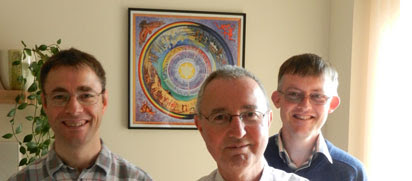
L-R: Mark Van Beeumen MSC, Ton Zwart MSC and Con O'Connell MSC
Thursday, 24 March 2011


Wednesday, 23 February 2011
The Birthday of Muhammad

Not all Muslims celebrate the birthday of their prophet Muhammad and not all who do, celebrate it on the same day. The Shiites celebrate it five days after the Sunnis do. This year the celebrations took place on February 15 and February 20 respectively.
Walking about in Aston it is easy to see which mosques take part in the celebration; they have their facades adorned with strings of little lights. The lights are not simply there to call the attention of passers-by. They have to do with the meaning of the feast itself. Light signifies wisdom and those Muslims who celebrate the birthday of Muhammad consider him 'the best of all creatures', a guiding light of God's wisdom.
They believe more; they also believe that the celebration of Muhammad's birthday brings blessings to those who honour his achievements, his moral conduct and his way of life. They experience the good influence of his eminent example of 'the last and greatest of all prophets', as they call him. It is this belief that makes ordinary faithful hang banners in their windows. They witness to Muhammad's importance in their lives and open themselves up for his benevolence.
Other Muslims frown on this kind of piety. They call the celebration of Muhammad's birthday an 'innovation', which was added to the true faith and deviated from it. What is at stake is the pre-eminence of the Qur'an, the holy book of the Muslims, that came straight down from heaven. Muhammad is just the messenger who passed on the divine words without adding anything of his own. Consequently, the birthday of Muhammad has no importance; after all he received his first revelation only at the age of forty.
The believers in Muhammad are not deterred and they celebrate his birthday with great joy. To them Muhammad is not just a prophet who passed on the divine words to others but he lived them himself to the full. This makes him special, a kind of saint, one who preceded them to where they hope to go themselves.
Ton
Monday, 17 January 2011
Advice Centre

The St James Advice and Community Centre is in danger of closing down. It has been in existence for 33 years and provided a great service to the migrant communities of Aston, mostly on issues of immigration and social benefits.
It all started very simple. The local vicar of the Church Of England was asked by recently arrived migrants to help out with their paper work. He did so with the help of a young man from Bangladesh who later studied law and became the director of the Centre. So from the beginning the Centre not only involved the Church of England but representatives from the migrant communities themselves. This is still very much the case, both with respect to the staff of the Centre and the Management Team. The Centre in its very heart reaches across ethnicity and across religion.
The reason for the imminent closure is the Birmingham City Council, the main sponsor of the St James Advice and Community Centre and of many other similar centres across the city. Times are bad and spending cuts of 20% or more were expected, but what was not expected was the interruption of subsidies altogether. Last December the City Council announced formally that its funding will stop by the end of March. It allows reapplication by July but for the intervening period the advice centres are on their own. What this means in fact is that the smaller centres with less financial capacity are forced to stop operations and lay off their workers. This is exactly what the St James Advice and Community Centre did: it sent redundancy notices to its seven staff.
It did more than this. It also collected 500 signatures of local residents who protested the way the City Council had made its funding decision and it involved the Birmingham Mail to put pressure on local politicians. One problem is that Aston is Labour territory, whereas the councillor and cabinet member for local services is Lib Dem. Political strife may be involved in another way as well: one of the two Labour councillors in the area is the former director of the St James Advice and Community Centre who built his reputation by his long-standing service in the Centre.
Attempts are on their way to continue the advice service on a voluntary basis, at least until the time that reapplication for funding can be made. But there is a hitch or two: Funding in the future may not be on the basis of an individual advice centre but only when they are grouped in clusters. What is more, advice centres should move away from face-to-face meetings with their clients and operate mainly via the internet and telephone connections. This would be disastrous for Aston: whether the Council likes it or not, migrant communities function mostly on the basis of face-to-face encounters.
Ton
Friday, 17 December 2010
English Language Learning
Every Wednesday I help out with English learning in a small community centre not too far from our home. The learners are all men, mostly from Bangladesh and Pakistan. They live in Aston and in the neighbouring communities of Lozells and Newtown. Classes start at midday which suites those of the men who work in Asian restaurants. They come home late at night and sleep until deep in the morning.
If I have learned one thing from assisting these learners, it is how difficult the English language is for them. Some had little education at home and have to acquire the additional skills of reading and writing the letters of the alphabet, one by one, both in small and capital letters. It takes them hours of practice to produce some satisfactory results. Others are a step further and know some reading and writing, but they have trouble in recognising words. They are able to spell the letters of a word separately, but they have difficulty in putting the letters together and hit on the word itself. The biggest group, however, reads and writes easily. They are functional literates and only have to cope with the considerable confusion the spelling of English language poses to them.
In English the same sounds can be represented by different letters or letter combinations, and the same letters can stand for different pronunciations. It is not only the vowels that are afflicted with this bad habit but some consonants as well. Moreover, you have the silent consonants which you are obliged to write but not allowed to pronounce. The learners find it utterly confusing and I can't blame them.
There is no way of explaining the differences. Rules do exist but there are so many exceptions that indeed the rules are made to be broken. Historical explanations are not very helpful either. They are highly complex and often more governed by coincidence than by logic. So, what it comes down to in the end, is that learners have just to memorise 'the way it is'.
The teaching of grammar relies heavily on memory as well. It is more a question of memorising sentences in certain situations than an explanation of the distinctions that underlie grammatical differences. Learners are taught how to approach their GP in a health centre, what to say when they go shopping, how to talk about their children's education etc. It is hoped that by means of adopting these sentences the learners gradually develop a feeling for the language and spontaneously start using the right grammatical constructions.
It seems to me that this is the way children learn a language, but children are fast learners and have excellent memories. My learners are adults, they need plenty of time and lots of hard work to put things to memory. A few hours of English once or twice a week is on the whole not enough.
Ton
If I have learned one thing from assisting these learners, it is how difficult the English language is for them. Some had little education at home and have to acquire the additional skills of reading and writing the letters of the alphabet, one by one, both in small and capital letters. It takes them hours of practice to produce some satisfactory results. Others are a step further and know some reading and writing, but they have trouble in recognising words. They are able to spell the letters of a word separately, but they have difficulty in putting the letters together and hit on the word itself. The biggest group, however, reads and writes easily. They are functional literates and only have to cope with the considerable confusion the spelling of English language poses to them.
In English the same sounds can be represented by different letters or letter combinations, and the same letters can stand for different pronunciations. It is not only the vowels that are afflicted with this bad habit but some consonants as well. Moreover, you have the silent consonants which you are obliged to write but not allowed to pronounce. The learners find it utterly confusing and I can't blame them.
There is no way of explaining the differences. Rules do exist but there are so many exceptions that indeed the rules are made to be broken. Historical explanations are not very helpful either. They are highly complex and often more governed by coincidence than by logic. So, what it comes down to in the end, is that learners have just to memorise 'the way it is'.
The teaching of grammar relies heavily on memory as well. It is more a question of memorising sentences in certain situations than an explanation of the distinctions that underlie grammatical differences. Learners are taught how to approach their GP in a health centre, what to say when they go shopping, how to talk about their children's education etc. It is hoped that by means of adopting these sentences the learners gradually develop a feeling for the language and spontaneously start using the right grammatical constructions.
It seems to me that this is the way children learn a language, but children are fast learners and have excellent memories. My learners are adults, they need plenty of time and lots of hard work to put things to memory. A few hours of English once or twice a week is on the whole not enough.
Ton
Friday, 29 October 2010
Monoculture
We are now three years in Aston and sometimes I have the feeling that the tide is running against us. We selected Aston mainly because it was a multicultural and multireligious neighbourhood, and we hoped very much to build bridges between people of differing background. We had no illusion about how difficult this would be: you can't force people to become friends with strangers! We knew it would be a slow process of establishing trusting relationships.
But shall we have the time to do so? Is our neighbourhood not changing from a multicultural community into a monoculture? The statistics have it that about 20% of the population of Aston is white English and Irish, but that is not the impression you get when you walk the streets. You hardly see any white people: they seem to have disappeared from the scene.
What is happening is that white people are still moving out of the neighbourhood. They follow their children who have moved out ahead of them in search of the employment opportunities no longer found in Aston. The same is happening, but to a lesser extent, to the Afro-Caribbean people. They are still present in good numbers, but they are ageing and their children are no longer with them. The empty places are being taken in part by new migrants, refugees from Africa and Asia, and economic migrants from Eastern Europe. It remains to be seen, however, how stable these new arrivals will be. This leaves the Asian population, from Pakistan and Bangladesh, already in the majority. They are a young population, fast growing in this country and with plenty of relatives in their countries of origin willing to come to England and hoping for a better life. They will occupy the empty places left by the other groups and as a consequence Aston will grow into a monocultural neighbourhood.
I like to emphasise that the processes underlying this development are all very natural, there is nothing sinister about them. Lots of individual decisions, all making sense by themselves, point in the same direction and the combined outcome is a monoculture.
How to react to this development? You can't stop the tide. I think, two things can be done. There are people in Aston among the white and the Afro-Caribbean population who do not want to move out. They see the variety that is still being present as a plus, as something to be appreciated and cherished. It will be important to spot these people and support them in whatever way we can. They show what a future of living together may look like. Secondly, when neighbourhoods continue to lose much of their variety, one needs to look beyond one's own neighbourhood and attempt to bring neighbourhoods of different kinds together. As somebody told me in a slightly different context: it will make the difference between a ghetto and an enclave.
Ton
But shall we have the time to do so? Is our neighbourhood not changing from a multicultural community into a monoculture? The statistics have it that about 20% of the population of Aston is white English and Irish, but that is not the impression you get when you walk the streets. You hardly see any white people: they seem to have disappeared from the scene.
What is happening is that white people are still moving out of the neighbourhood. They follow their children who have moved out ahead of them in search of the employment opportunities no longer found in Aston. The same is happening, but to a lesser extent, to the Afro-Caribbean people. They are still present in good numbers, but they are ageing and their children are no longer with them. The empty places are being taken in part by new migrants, refugees from Africa and Asia, and economic migrants from Eastern Europe. It remains to be seen, however, how stable these new arrivals will be. This leaves the Asian population, from Pakistan and Bangladesh, already in the majority. They are a young population, fast growing in this country and with plenty of relatives in their countries of origin willing to come to England and hoping for a better life. They will occupy the empty places left by the other groups and as a consequence Aston will grow into a monocultural neighbourhood.
I like to emphasise that the processes underlying this development are all very natural, there is nothing sinister about them. Lots of individual decisions, all making sense by themselves, point in the same direction and the combined outcome is a monoculture.
How to react to this development? You can't stop the tide. I think, two things can be done. There are people in Aston among the white and the Afro-Caribbean population who do not want to move out. They see the variety that is still being present as a plus, as something to be appreciated and cherished. It will be important to spot these people and support them in whatever way we can. They show what a future of living together may look like. Secondly, when neighbourhoods continue to lose much of their variety, one needs to look beyond one's own neighbourhood and attempt to bring neighbourhoods of different kinds together. As somebody told me in a slightly different context: it will make the difference between a ghetto and an enclave.
Ton
Friday, 8 October 2010
Closures

When we arrived in Aston three years ago, the Guild Arms, the pub at the corner of Witton and Ettington roads was all boarded up. Nothing has changed since then in spite of several attempts to auction off the pub. Perhaps the problem is that the land belonging to the pub has been sold and redeveloped. In fact, the very house we are living in is built on it, so that I cannot really complain. Just the same, selling off the open space of a property may make it more difficult to sell the rest, in particular if it concerns a listed building, as the pub is said to be. The result is that what should be a beauty to look at becomes an eyesore.
Recently, at the beginning of the academic year, another building in Aston was closed down. It was not an old building at all: City Academy Aston opened its doors only in 2004 and the building it occupied was newly constructed. It is sad to see a building like that go out of use. Apparently, City Academy, which has four other campuses in Birmingham, saw no future in keeping the Aston campus open. One wonders what will happen to the building now?
Opposite City Academy Aston, the Broadway School, the largest secondary school in the area with 1,300 pupils, has its campus for the 7 and 8 years. It will not remain in its present location for long. If everything goes according to schedule, the Aston campus will join the main campus of the Broadway School in January 2011. The unanswered question is what will happen to the vacated building and how will it be protected against vandalism?
The Aston Library dates back to the time when Aston was still an independent coumcil, that is before 1911 when the amalgation with Birmingham City took place. Its long history, however, does not guarantee its continued existence. There are no less than 40 community libraries in Birmingham and all are under review for delivering value for money. The announced spending cuts may mean that a number of libraries will be closed and its services transferred to mobile libraries. If this happens to the library in Aston another building will close down, as Aston Pride which has its offices in the same building, will stop operations in March 2011.
All buildings under discussion lie within a short distance of one another: standing at the corner where the pub is one has the other three buildings in one's vision. While going around taking pictures of them a resident approached me and commented that Aston is becoming a depressive place. He was not just talking about the buildings, but about the high unemployment and the benefit cuts as well. For him Aston was not the place to be.
Ton

Friday, 20 August 2010
Ramadan

Our mosque in Ettington Road underwent a facelift. It was no coincidence that this happened shortly before Ramadan. After all, Ramadan is for Muslims the most important month of the year when they visit the mosque more often than they usually do. We can notice it not just by the number of pedestrians who pass by our house but also by the number of cars that clog our street.
Fasting in summer time is no small feat. The hours without food and drink make up most of the day, fifteen hours or more. What seems particularly vexing is the abstinence of even a drop of water. On warm days when one is doing physical work, this seems not just nearly impossible but positively unhealthy as well.
Muslim apologists, however, maintain that fasting is healthy for body and soul. They claim that it cleanses the body from all kinds of toxic substances that accumulate in the body thoughout the year. The fast of Ramadan removes them from the body making the person more healthy as a result. It seems to me a rather spurious argument tagged on to the religious motivation for fashionable reasons.
In truth, Ramadan is foremost a religious exercise. It is an act of willingly submitting oneself to God who in the Qur'an (2:183) prescribes fasting to Muslims, as to others before them, by whom Jews and Christians are meant. The purpose of the fast is explicitly stated: it is to be mindful of God.
Muslims are mindful of God by not giving in to their natural urges to eat, to drink and have sex. It requires an effort and by that effort they show how highly they regard their God in their lives, much higher than their very real bodily needs.
The stated purpose of the fast is also the reason that the observance of Ramadan involves a lot more than fasting. In order to be mindful of their God Muslims read the whole of the Qur'an during the month of Ramadan. In addition, they strengthen their bonds with family, neighbours and community. The poor are not forgotten either; Ramadan is pre-eminently the month of almsgiving.
Ton
Tuesday, 3 August 2010
Muslim Prayer
Pious Muslims pray five times a day; all Muslims should but not all Muslims are pious Muslims. Like people of other religions they do not always live up to the obligations of their faith. In particular younger people may be amiss in fulfilling their religious duties. They live much more in a culturally divided world than their parents who, it is said, tend to feel foremost at home in their culture of origin. Control of the mosques is in the hands of the older generation and young people often have little affinity with them. This may explain the fact that it is mostly middle-aged and elderly men who pass by our window five times a day on their way to the mosque nearly opposite our house.
This being said, one should not underestimate the power of prayer. It gives structure to the lives of pious Muslims by dividing their day into five fixed points, around which their day revolves. The hours are compulsory and cannot be changed at will. This does not mean that all pray at the same time to the minute. I often see men still entering the mosque for prayer while others are already on their way out.
Muslim prayer is very much an individual act of piety, even where many Muslims are together in the same mosque praying at more or less the same time. One Muslim I met at an interfaith meeting last year - and he had me thinking about it ever since - expressed his experience in this way: "Prayer gives me the opportunity to stand before the Almighty with nothing in between; it is paradise in front and hell at the back".
I am not sure whether I get him right, but he seems to express an experience that is not alien to me as a Christian either. When you are blessed in prayer with a deep awareness of God, as sometimes is the case, you know that you are face to face with the Absolute One, with Life and Happiness in person. Cut off from Him or Her you fall in an abyss of darkness and nothingness.
Ton
This being said, one should not underestimate the power of prayer. It gives structure to the lives of pious Muslims by dividing their day into five fixed points, around which their day revolves. The hours are compulsory and cannot be changed at will. This does not mean that all pray at the same time to the minute. I often see men still entering the mosque for prayer while others are already on their way out.
Muslim prayer is very much an individual act of piety, even where many Muslims are together in the same mosque praying at more or less the same time. One Muslim I met at an interfaith meeting last year - and he had me thinking about it ever since - expressed his experience in this way: "Prayer gives me the opportunity to stand before the Almighty with nothing in between; it is paradise in front and hell at the back".
I am not sure whether I get him right, but he seems to express an experience that is not alien to me as a Christian either. When you are blessed in prayer with a deep awareness of God, as sometimes is the case, you know that you are face to face with the Absolute One, with Life and Happiness in person. Cut off from Him or Her you fall in an abyss of darkness and nothingness.
Ton
Monday, 21 June 2010
Hamara Project
Hamara means 'ours' in the Urdu language, one of the languages of the Indian subcontinent. It was used for an educational project which was user-led, meaning that the learners themselves determined to a large extent the activities in which they participated.
The project was initiated by BEEAS [Birmingham Ethnic Education & Advisory Service] and had two excellent facilitators, whom I happen to know as we followed the same course for assistant English language teacher last year. They did not simply facilitate the group process of the forty women (two batches) who made up the Hamara Project, but they also made a great effort to recruit the women learners themselves.
It is interesting to note how they did it, for recruitment may well be the more difficult part of the Hamara Project, more difficult than the educational sessions proper. I quote from the evaluation report: "They delivered flyers to every road in the target area and handed out leaflets in school playgrounds. They spoke to women on the street and at shops and they worked closely with the learning mentors at prince Albert and Mansfield Schools to identify potential recruits." The two facilitators, women of Asian origin themselves, really reached out and made full use of their own backgrounds and language abilities to overcome suspicion, shyness and fear on the part of their target learners.
As it turned out they were very successful. They recruited the kind of women they wanted to recruit: those in social isolation who up to now had not participated in any sort of educational programme. Again I quote from the evaluation report: "[...] for many of the women this was the first opportunity in the whole of their lives to join a programme. For some it was the first opportunity to participate in an activity outside of the family circle and to attend independently. For them, this Project offered a first taste of independence as adult women, and they, naturally, were very nervous and had a fear of speaking out within the group setting."
The learning process did not simply take place in the small community centre which opened its doors to the women learners. The informality of the programme meant that they could go out and visit other places like the nearby library and health centre or musea and art galleries in the heart of the City. Some of the women had to learn some basic social skills: "For example, when the women all caught the bus together to go to the City Centre, they had no idea that they had to wait for people to get off the bus before they pushed their way on. They did not understand the critical comments that came from the other bus travellers who viewed their behaviour as being 'rude' rather than being a lack of understanding. The facilitators also encouraged the women to make eye contact wiht strangers with whom they were undertaking transactions rather than look away as, again, this could be misunderstood."
All activities included an English and a health component, which was much appreciated by the women learners. "One beneficiary explained that, although she had lived in England for 14 years she was still unable to speak the language. This was due to the fact that when she arrived in the country she lived with her extended family and stayed within the home. She brought up her children and now that they are grown up she wished to learn to speak more fluently. She said that her lack of language skills embarassed her especially when answering the telephone or going to hospital appointments. She especially enjoyed the ESOL [English for Speakers of Other Languages] component of the programme."
A lasting benefit of the project is that the women made friends with one another. They did not want to lose each other's company and they did not want the programme to stop. BEEAS acknowledged that you cannot make people enthusiastic and then leave them out in the cold. They managed a continuation of the programme. albeit in a diminished form because of financial constraints.
Ton
The project was initiated by BEEAS [Birmingham Ethnic Education & Advisory Service] and had two excellent facilitators, whom I happen to know as we followed the same course for assistant English language teacher last year. They did not simply facilitate the group process of the forty women (two batches) who made up the Hamara Project, but they also made a great effort to recruit the women learners themselves.
It is interesting to note how they did it, for recruitment may well be the more difficult part of the Hamara Project, more difficult than the educational sessions proper. I quote from the evaluation report: "They delivered flyers to every road in the target area and handed out leaflets in school playgrounds. They spoke to women on the street and at shops and they worked closely with the learning mentors at prince Albert and Mansfield Schools to identify potential recruits." The two facilitators, women of Asian origin themselves, really reached out and made full use of their own backgrounds and language abilities to overcome suspicion, shyness and fear on the part of their target learners.
As it turned out they were very successful. They recruited the kind of women they wanted to recruit: those in social isolation who up to now had not participated in any sort of educational programme. Again I quote from the evaluation report: "[...] for many of the women this was the first opportunity in the whole of their lives to join a programme. For some it was the first opportunity to participate in an activity outside of the family circle and to attend independently. For them, this Project offered a first taste of independence as adult women, and they, naturally, were very nervous and had a fear of speaking out within the group setting."
The learning process did not simply take place in the small community centre which opened its doors to the women learners. The informality of the programme meant that they could go out and visit other places like the nearby library and health centre or musea and art galleries in the heart of the City. Some of the women had to learn some basic social skills: "For example, when the women all caught the bus together to go to the City Centre, they had no idea that they had to wait for people to get off the bus before they pushed their way on. They did not understand the critical comments that came from the other bus travellers who viewed their behaviour as being 'rude' rather than being a lack of understanding. The facilitators also encouraged the women to make eye contact wiht strangers with whom they were undertaking transactions rather than look away as, again, this could be misunderstood."
All activities included an English and a health component, which was much appreciated by the women learners. "One beneficiary explained that, although she had lived in England for 14 years she was still unable to speak the language. This was due to the fact that when she arrived in the country she lived with her extended family and stayed within the home. She brought up her children and now that they are grown up she wished to learn to speak more fluently. She said that her lack of language skills embarassed her especially when answering the telephone or going to hospital appointments. She especially enjoyed the ESOL [English for Speakers of Other Languages] component of the programme."
A lasting benefit of the project is that the women made friends with one another. They did not want to lose each other's company and they did not want the programme to stop. BEEAS acknowledged that you cannot make people enthusiastic and then leave them out in the cold. They managed a continuation of the programme. albeit in a diminished form because of financial constraints.
Ton
Thursday, 22 April 2010
Election fever
May 6 is election day for both the members of parliament and for the local councillors. As a resident of Aston I have been granted the right to participate in the election of local councillors, but being a Dutch national excludes me from the British parliamentary elections.
The arrival of my poll card heightened my interest in Aston politics. As part of trying to understand the dynamics in the neighbourhood I had already searched the internet for information about past elections. What it made clear was that only two parties are vying for political control of the neighbourhood: Labour and the Liberal Democrats. All the other parties stand no chance at all, including the Conservatives.
What leapt to the eye was that political campaigns are hard-fought in Aston and make use of dirty tricks. Candidates accuse one another of telling lies about their opponents trying to smear their reputations. This went so far that at the day of one of the elections a sound van was going through the streets of Aston blaring the alleged abuse of social benefit claims by the opposition candidate. Accusations of vote rigging and ballot irregularities flew to and fro as well.
The present elections are in comparison relatively quiet. What I have come across with so far is a rather blatant attempt to mobilise the Muslim vote. Last Friday near our house I found a number of leaflets scattered on the ground. Apparently, they had been distributed after the Friday service at the mosque in our street. The Lib Dems were responsible for these particular leaflets. Under the heading "What Labour don't want you to know", they listed eight items all meant to arouse the feelings of the local Muslim population. Just to mention the first, the last and the one in the middle: "Labour's illegal war in Iraq killed hundreds of thousands of innocent people and children"; "Labour have made major changes to the Immigration Act, making it harder for your families to join you"; and "Labour are introducing intrusive full body scans at Britain's Airports".
I have not yet seen the answer of Labour to this kind of campaigning, but no doubt there will be some response or other. Whatever it will be, I do hope that the response will avoid two glaring shortcomings of the leaflets: they just condemn the other party without any alternative policy proposal, and secondly, they only address the Muslim population and ignore the other (minority) residents in the neighbourhood.
Finally, a conspicuous omission. It is a well-known fact that unemployment is the biggest problem in Aston and for that matter in the West-Midlands as a whole. In particular, young people stand very little chance to land a job. A fact like this cannot be ignored than at our own peril.
Ton
The arrival of my poll card heightened my interest in Aston politics. As part of trying to understand the dynamics in the neighbourhood I had already searched the internet for information about past elections. What it made clear was that only two parties are vying for political control of the neighbourhood: Labour and the Liberal Democrats. All the other parties stand no chance at all, including the Conservatives.
What leapt to the eye was that political campaigns are hard-fought in Aston and make use of dirty tricks. Candidates accuse one another of telling lies about their opponents trying to smear their reputations. This went so far that at the day of one of the elections a sound van was going through the streets of Aston blaring the alleged abuse of social benefit claims by the opposition candidate. Accusations of vote rigging and ballot irregularities flew to and fro as well.
The present elections are in comparison relatively quiet. What I have come across with so far is a rather blatant attempt to mobilise the Muslim vote. Last Friday near our house I found a number of leaflets scattered on the ground. Apparently, they had been distributed after the Friday service at the mosque in our street. The Lib Dems were responsible for these particular leaflets. Under the heading "What Labour don't want you to know", they listed eight items all meant to arouse the feelings of the local Muslim population. Just to mention the first, the last and the one in the middle: "Labour's illegal war in Iraq killed hundreds of thousands of innocent people and children"; "Labour have made major changes to the Immigration Act, making it harder for your families to join you"; and "Labour are introducing intrusive full body scans at Britain's Airports".
I have not yet seen the answer of Labour to this kind of campaigning, but no doubt there will be some response or other. Whatever it will be, I do hope that the response will avoid two glaring shortcomings of the leaflets: they just condemn the other party without any alternative policy proposal, and secondly, they only address the Muslim population and ignore the other (minority) residents in the neighbourhood.
Finally, a conspicuous omission. It is a well-known fact that unemployment is the biggest problem in Aston and for that matter in the West-Midlands as a whole. In particular, young people stand very little chance to land a job. A fact like this cannot be ignored than at our own peril.
Ton
Subscribe to:
Posts (Atom)